
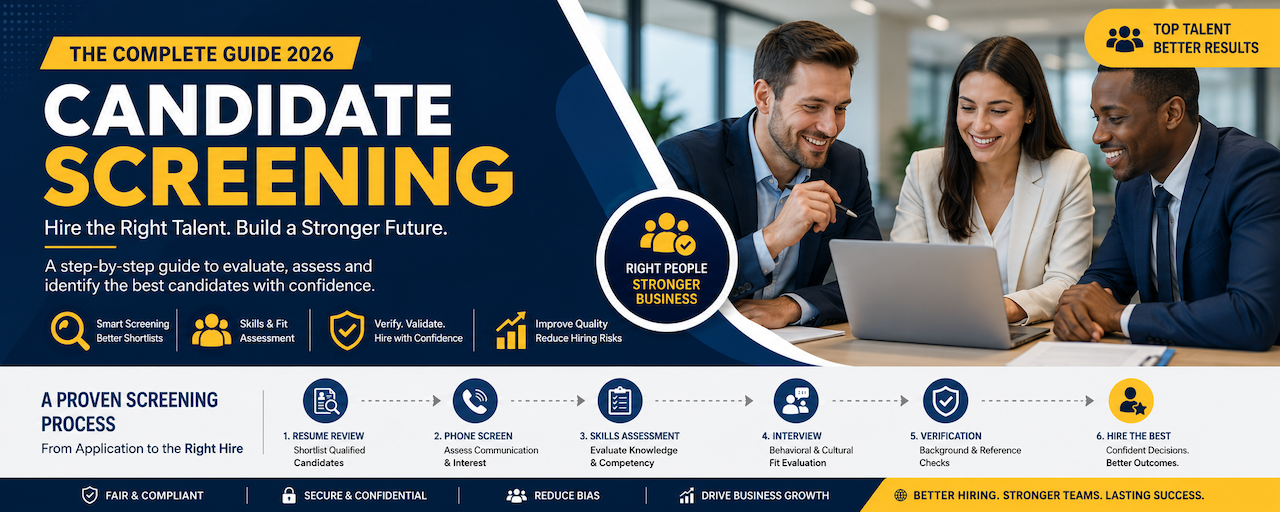
Hiring the right employee has become more challenging than ever. With remote work, global talent pools, AI-generated resumes, and increasing competition for skilled professionals, organizations need a smarter approach to identifying qualified candidates.
Candidate screening is one of the most important stages of the recruitment process. A structured screening process helps employers eliminate unsuitable applicants, reduce hiring costs, improve employee retention, and build stronger teams.
Whether you're hiring for a startup, SME, multinational company, government agency, or recruitment firm, this guide explains everything you need to know about candidate screening in 2026.
Candidate screening is the process of evaluating job applicants to determine whether they meet the qualifications, experience, skills, and cultural fit required for a position before advancing to interviews or receiving a job offer.
An effective candidate screening process includes:
Candidate screening is the first major step after receiving job applications.
Its purpose is to narrow down a large applicant pool into a shortlist of highly qualified candidates.
Rather than interviewing hundreds of applicants, employers focus only on individuals most likely to succeed.
Good screening saves:
Recruitment has evolved significantly.
Today's hiring managers face:
Without proper screening, companies risk hiring employees who:
Strong screening significantly improves hiring quality.
Structured evaluations reduce emotional bias and improve objectivity.
Hiring managers spend less time interviewing unsuitable candidates.
Bad hires can cost thousands of dollars in recruitment, onboarding, and lost productivity.
Proper screening minimizes these expenses.
Employees who genuinely fit the role tend to remain with the company longer.
Qualified employees require less training and become productive more quickly.
Professional hiring experiences improve employer branding.
Satisfied candidates—even unsuccessful ones—are more likely to recommend your organization.
Before screening candidates, clearly define:
A well-defined role creates consistent screening standards.
Evaluate each resume based on:
Does the applicant meet minimum educational requirements?
Look for:
Examples include:
Examples:
Common reasons include:
Phone interviews verify:
Phone screenings typically last 15–30 minutes.
Modern employers increasingly rely on practical evaluations.
Examples include:
Behavioral interviews predict future performance by examining past experiences.
Examples:
Evaluate whether the candidate aligns with:
Avoid using "culture fit" to exclude people based on personal background. Focus on shared professional values and the ability to work effectively within the organization's environment.
Verify:
Always comply with applicable privacy, employment, and anti-discrimination laws.
Speak with former managers whenever possible.
Ask:
Score candidates using standardized criteria.
Example evaluation matrix:
| Category | Weight |
|---|---|
| Experience | 25% |
| Skills | 25% |
| Interview Performance | 20% |
| Problem Solving | 15% |
| Communication | 10% |
| Cultural Alignment | 5% |
Structured scorecards help reduce bias and improve consistency.
Fastest method for large applicant pools.
Best for:
AI can assist by:
Use AI as a decision-support tool rather than the sole decision-maker. Human oversight helps identify context, reduce unfair outcomes, and ensure compliance with employment laws.
Includes:
Candidates answer recorded interview questions before live interviews.
Benefits:
Useful for:
Watch for:
Approach potential concerns carefully and give candidates an opportunity to clarify before drawing conclusions.
Avoid:
Many organizations use recruitment platforms that provide:
Choose tools based on your hiring volume, budget, integration needs, and compliance requirements.
Track the effectiveness of your screening process using metrics such as:
Regularly reviewing these metrics helps identify opportunities for improvement.
Recruitment is becoming more data-driven and technology-enabled. Organizations can expect to see:
Candidate screening is the process of reviewing and evaluating job applicants to identify those who best match a role's requirements before progressing to interviews or job offers.
The timeline depends on the role and applicant volume, but many organizations aim to complete initial screening within a few business days to keep candidates engaged.
No. AI can automate repetitive tasks such as resume parsing and scheduling, but experienced recruiters remain essential for evaluating context, conducting interviews, building relationships, and making final hiring decisions.
Clearly defining job requirements and using consistent, structured evaluation criteria are among the most important factors in making quality hiring decisions.
Employers can use standardized scorecards, structured interviews, diverse interview panels, and regular training on fair hiring practices while ensuring compliance with applicable employment laws.
Candidate screening is the foundation of successful hiring. A thoughtful, structured process helps organizations identify high-performing talent while reducing hiring risks, controlling recruitment costs, and creating a positive candidate experience.
As hiring continues to evolve in 2026, the most successful employers will combine technology with sound human judgment. By focusing on skills, verified qualifications, consistent evaluation methods, and clear communication, organizations can build stronger teams and make hiring decisions that support long-term business growth.

